Preliminary Planning and Heritage Appraisal (PPHA)
High Street House, Bexley High Street, Bexley Village, Kent DA5 1JX
Engagement of a heritage architect to support purchase, attend a pre-application meeting with the London Borough of Bexley (LBB), and subsequently prepare and submit a Listed Building Consent (LBC) application for agreed restoration works. · London Borough of Bexley
Worked example: the PPHA as issued on 24 July 2026, with the client’s name withheld.
Issued on 24 July 2026, this PPHA cites the National Planning Policy Framework (NPPF) of December 2024. That framework was replaced on 17 August 2026; HeritageAI now applies the current framework, Chapter 20, Policies HE1 to HE10.
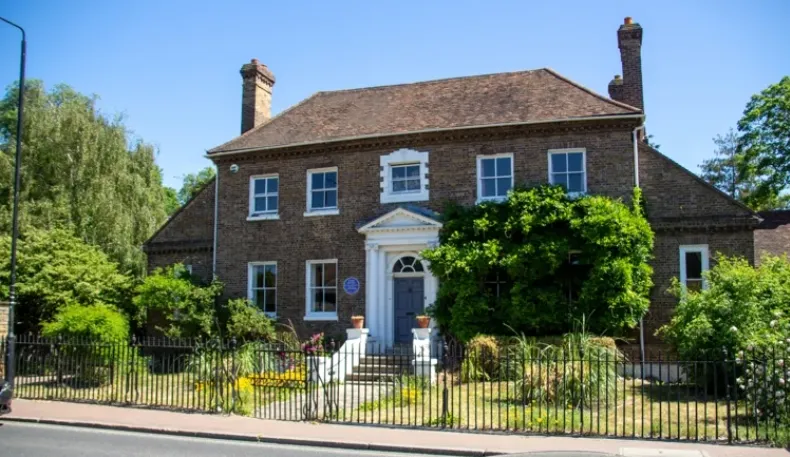
A two-storey brown brick house with a hipped tile roof, two chimneys, white-framed sash windows, and a white-painted classical doorcase with fanlight, set behind a black iron railing fence with a mature planted garden, photographed under a clear blue sky.
The property is a confirmed Grade II listed building within the Old Bexley Conservation Area requiring LBC for any works affecting its special architectural or historic interest; risk is manageable but scheme definition is currently absent, making full assessment premature.
S1 — Designation & NHLE status
Verified — NHLES2 — Additional designations
Review required| Designation | Status |
|---|---|
| Conservation area | Yes |
| AONB / National Landscape | No |
| Scheduled monument | Unconfirmed |
| SSSI / SAC / SPA | Unconfirmed |
The applicant's own marketing text explicitly states the property sits within the Old Bexley Conservation Area, confirming that designation. The verified National Heritage List for England (NHLE) grade (II) matches the applicant-supplied grade; no discrepancy to record. The list entry date of last amendment is 17 December 1980. The blue plaque commemorating John Thorpe and the indirect connection to Lullingstone Roman Villa are communal significance factors to address in any heritage statement.
S3 — Policy framework
NPPF 2024Adopted local plan
London Borough of Bexley (reference E60000204)
A neighbourhood plan may apply in this area — check with the local authority.
An Article 4 Direction may remove some permitted development rights in this area — check with the local authority.
NPPF 2024 para 208
Requires the Local Planning Authority (LPA) to identify and assess the significance of heritage assets affected by a proposal; directly applicable to this Grade II listed building and Conservation Area setting.
NPPF 2024 para 214
Applies the less-than-substantial harm test where proposals affect designated heritage assets; the restoration scope will determine whether harm is caused and whether public benefits sufficiently outweigh it.
Historic England GPA2
Historic England's Good Practice Advice Note 2 (GPA2) on managing significance in decision-taking sets out the level of evidence and analysis required in a heritage statement to accompany an LBC application.
P(LBCA) Act 1990 s.7
The Planning (Listed Buildings and Conservation Areas) Act 1990 section 7 makes it a criminal offence to execute works affecting the character of a listed building without LBC; LBC must be secured before any physical works commence.
S4 — Consent requirements
Action requiredTypical costs & fees
Estimate onlyThe figures below are statutory national planning application fees for England (from 1 April 2026). Your local planning authority confirms the exact fee payable when you submit — this is an estimate only and excludes Community Infrastructure Levy, pre-application advice charges, and professional fees.
The statutory planning fee shown applies to the planning permission element. Listed Building Consent remains nationally fee-exempt.
Professional fees
Depending on the scope of works, you may need to commission some or all of the following professional roles. Fees vary by appointment, complexity, and location — obtain quotes before committing.
- Conservation architect or accredited conservation specialist
- Heritage consultant / heritage impact assessment author
- Planning consultant
- Structural engineer
- Building surveyor (condition or measured survey)
- Cost consultant / quantity surveyor
- Mechanical and electrical engineer (where services are affected)
- Landscape architect (where external works are proposed)
- Arboricultural consultant (where trees may be affected)
- Archaeological consultant (where ground disturbance is proposed)
S5 — Significance & heritage impact — Assessment
No specific scheme of works has yet been defined, so a detailed impact assessment cannot be made at this stage. Any restoration works affecting original fabric — including the wrought-iron railings, fielded-panel door, Ionic columns, fanlight, staircase, floorboards, or cellar structure — will be scrutinised against the significance of these elements. A proportionate heritage statement demonstrating a fabric-first, like-for-like approach will be essential to support the LBC application.
Gaps & actions
5 gaps · 5 actionsGaps
Scheme of Works Undefined
No schedule of proposed works has been provided. The scope of restoration must be defined before consent requirements, heritage impact, and pre-application advice can be meaningfully assessed.
Condition Survey Absent
No structural or condition survey of the listed building has been submitted. A professional condition survey is required to identify areas of disrepair, inform the scope of restoration, and evidence the need for any proposed interventions.
Heritage Statement Not Prepared
No heritage statement assessing significance in line with GPA2 and Conservation Principles 2008 has been produced. This document is a mandatory requirement for an LBC application and must be prepared by a suitably qualified heritage professional.
Scheduled Monument Status Unconfirmed
The property's proximity to known Roman archaeology and Lullingstone Roman Villa's broader context means the potential for sub-surface remains on site cannot be ruled out. Scheduled Monument (SM) status and archaeological risk must be confirmed with Historic England and LBB.
Pre-Application Advice Not Yet Sought
No pre-application discussions have taken place with LBB's conservation officer. Pre-application advice is required before the scheme is finalised to reduce the risk of an unacceptable LBC application.
Actions
Appoint a Heritage Architect
The applicant must appoint a heritage architect with demonstrable experience of Grade II listed Georgian buildings to lead the pre-application process and prepare the LBC application.
Commission a Condition Survey
Instruct a qualified building surveyor to carry out a full condition survey of the listed building, covering structure, roof, rainwater goods, windows, doors, ironwork, internal fabric, and cellar. This underpins the scheme definition.
Define the Scheme of Works
Working with the heritage architect and condition survey findings, the applicant must prepare a clear schedule of proposed works prior to approaching LBB at pre-application stage.
Request Pre-Application Meeting with LBB Conservation Officer
Submit a formal pre-application enquiry to LBB, including a site description, draft schedule of works, and photographs, to secure a pre-application meeting with the conservation officer and heritage architect present.
Confirm Archaeological Risk
Contact LBB's archaeological adviser and Historic England to confirm whether any part of the site carries SM designation or archaeological constraint, and whether a desk-based assessment or watching brief condition is likely.
S6 — Other consultants required
Action requiredBased on the proposed works, the following specialist consultants or surveys are likely to be required in addition to the heritage planning submission:
Building Surveyor (historic buildings)
Required to carry out a condition survey of the listed fabric, including roof, structure, historic joinery, ironwork, and cellar, to inform a proportionate and evidenced schedule of works.
Structural Engineer
The building has been described as requiring restoration after a period of neglect; a structural engineer with listed building experience should assess stability, particularly of the roof, floor structures, and cellar.
Archaeologist (desk-based assessment)
Given the known Roman archaeology associated with John Thorpe's notes and proximity to Lullingstone Roman Villa, an archaeologist should be engaged to assess sub-surface risk and advise on any watching brief requirements.
Specialist Joinery / Conservation Craftsperson
The six-fielded-panel door, semi-circular fanlight, wrought-iron railings, and internal staircase are character-defining features requiring specialist conservation-grade repair rather than standard building trades.
Official List Entry — National Heritage List for England
VerifiedRetrieved directly from the National Heritage List for England (NHLE), the official statutory register maintained by Historic England. This data is verified, not AI-generated. The full official list entry, including the architectural description used to define the building's significance, can be read in full at: https://historicengland.org.uk/listing/the-list/list-entry/1064245. HeritageAI does not reproduce the official description text automatically — please refer to the source record above before finalising any application.
Recommended next steps
- Appoint a heritage architect with Grade II listed building experience to lead the consenting process.
- Commission a professional condition survey to establish the building's current state and inform a defined schedule of works.
- Submit a pre-application enquiry to LBB and arrange an on-site meeting with the conservation officer to discuss the proposed restoration approach in principle.
- Prepare a heritage statement in accordance with GPA2 and Historic England's Conservation Principles 2008, assessing significance and the impact of proposed works.
- Once pre-application advice is received and the scheme is agreed in principle, prepare and submit the formal LBC application with supporting heritage statement, drawings, and specification.
Glossary of terms & acronyms
- PPHA
- Preliminary Planning and Heritage Appraisal — an early-stage professional assessment of planning and heritage designation, risk, and consent requirements for a property, produced before a formal application is made.
- LBC
- Listed Building Consent — the statutory consent required from the Local Planning Authority before carrying out any works that would affect the character of a listed building.
- NHLE
- National Heritage List for England — the official register of all nationally designated heritage assets in England, maintained by Historic England.
- NPPF
- National Planning Policy Framework — the government's overarching planning policy document for England, setting out how planning decisions should be made.
- LPA
- Local Planning Authority — the council responsible for determining planning and listed building consent applications in a given area; here, the London Borough of Bexley.
- LBB
- London Borough of Bexley — the Local Planning Authority for this property.
- GPA2
- Good Practice Advice Note 2 — Historic England guidance on managing significance in decision-taking, setting out the evidence expected to accompany heritage consent applications.
- SM
- Scheduled Monument — a nationally important archaeological site or historic building given legal protection under the Ancient Monuments and Archaeological Areas Act 1979.
- PP
- Planning Permission — the statutory consent required for development as defined by the Town and Country Planning Act 1990.
- P(LBCA) Act 1990
- Planning (Listed Buildings and Conservation Areas) Act 1990 — the primary legislation governing the protection and consenting of listed buildings and conservation areas in England.
What comes after the PPHA: the Statement of Heritage Significance, the Heritage Impact Assessment and the Planning & Heritage Statement (P&HS). See all four for one project.
READ THE FULL SET